Vermiculite is one of the clay minerals. Vermiculite is an aluminium-iron-magnesium-silicate, which belongs to the mica group because it is has a similar structure and appearance and forms flaky crystals in the same way. The name of the vermiculite mineral comes from the Latin word vermiculus: "little worm".
Vermiculit / Vermiculite
Mineralogical
Structure and manufacturing process
Raw vermiculite consists of thin, flat little plates. The exfoliation
(expansion) takes place at a high temperature (800 - 1000 °C) without
adding other substances. With the produced water vapour (reduction of
the crystal water), the individual layers of the structure are forced
apart. The volume of the vermiculite particles hereby enlarge by around
20 times. Expanded vermiculite is produced in various grain sizes.
Properties
pH-value approx. 7.5
Sintering temperature approx. 1,260° C
Melting point approx. 1,315° C
Humidity 1-1.5% after expansion
Trade hygiene - no silicosis danger
Non-flammable class A1 according to DIN 4102
Thermal conductivity value 0.07 W/mK according to DIN 4108
Sintering temperature approx. 1,260° C
Melting point approx. 1,315° C
Humidity 1-1.5% after expansion
Trade hygiene - no silicosis danger
Non-flammable class A1 according to DIN 4102
Thermal conductivity value 0.07 W/mK according to DIN 4108
Thermal conductivity figures
The following diagram shows the thermal conductivity figures of
vermiculite granulations at -100°C to +500°C average temperature. At
higher temperatures, due to the stronger temperature flow (convection), a
smaller granulation is recommended. However, you can reduce the thermal
flow when using coarser granulation if the material is carefully
pressed by around 10% upon installation.
Vermiculite is an environmentally-friendly product which can be returned to nature as a recyclable material.
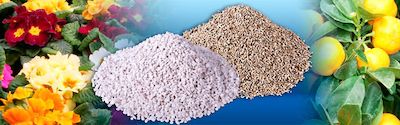
Vermiculite is an important basic module in the Building industry, in Industry, in Fire protection, in Gardening and in Animal care.
Areas of application
The usual application areas for vermiculite in a loose bulk:
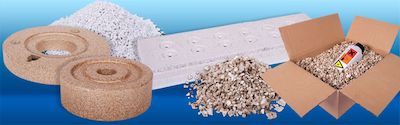
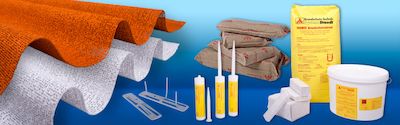
As insulation in structural engineering, as back insulation in industrial furnace construction and as a cover mass in the iron and steel industry. An interesting use of vermiculite is in cast moulding for slow, targeted cooling of larger moulded parts.
Vermiculite has an impact absorbing effect as a light, compressible bulk product. Together with huge absorption capacity, vermiculite is the perfect packaging aid for both dangerous liquids and goods as risk of impacts. Due to this distinctive absorption effect, vermiculite is particularly suitable as a binder for aggressive chemicals and solvents.
Chemical average analysis
- SiO2 35-41%
- P2O5 0.2-2%
- Al2O3 6-9.5%
- Li2O 0.03%
- TiO2 0.6-1.4%
- ZrO2 traces
- Fe2O3 6-9.5%
- Cr2O3 0.01-0.15
- Na2O 0.80%
- F 0.2-0.8%
- K2O 3-6%
- SO3 0.02%
- S 0.18%
- H2O + 105 C 5.18%
- Cl 0-0.5%
- H2O - 105 C 6.02%
- FeO 1.17%
- NiO traces
- V2O3 traces
- MuO 0.30%
- MgO 21.5-25.5%
- CoO traces
- CaO 2-6%
- BaO traces
Vermiculite as an aggregate
When using vermiculite as an aggregate (e.g. in back filling masses, in
plaster), practice has shown that due to the special properties under
temperature differences, the resulting tensions are compensated and the
development of cracks is reduced to a minimum. Furthermore, adhesion to
the base is so good that damages in the overall structure do not occur.
Ground vermiculite
Vermiculite can be ground down to 2 - 3 microns. The typical plate structure is always maintained. The space weight is at 250 - 300 kg/m³. Ground vermiculite can be used as a light, inactive inflammable filler e.g. in soundproofing masses, fire-resistant paints, mortars, lubricants, plywood boards, plastics, to avoid the forming of welding beads outside of the welding area and as a base material for herbicides and insecticides.
| Granulation 0 ( 0 - 1 mm ) | |
| Bulk weight approach 120-130 kg/m³ | |
| Dimension | Proportion |
| 2.0 - 1.0 mm | % |
| 1.0 - 0.5 mm | % |
| 0.5 - 0.25 mm | % |
| < 0.25mm | % |
| Granulation 2 ( 0 - 3 mm ) | |
| Bulk weight approach 85-90 kg/m³ | |
| Dimension | Proportion |
| 5.6 - 3.15 mm | % |
| 3.15 - 2.0 mm | % |
| 2.0 - 0.5 mm | % |
| < 0.5 mm | % |
| Granulation 4 ( 0 - 8 mm ) | |
| Bulk weight approach 75-80 kg/m³ | |
| Dimension | Proportion |
| 10.0 - 8.0 mm | % |
| 8.0 - 5.6 mm | % |
| 5.6 - 3.15 mm | % |
| 3.15 - 2.0 mm | % |
| < 2.0 mm | % |
| Granulation 1 ( 0 - 2 mm ) | |
| Bulk weight approach 100-110 kg/m³ | |
| Dimension | Proportion |
| 2.8 - 2.0 mm | % |
| 2.0 - 1.0 mm | % |
| 1.0 - 0.5 mm | % |
| 0.5 - 0.25 mm | % |
| < 0.25 mm | % |
| Granulation 3 ( 0 - 5 mm ) | |
| Bulk weight approach 80-85 kg/m³ | |
| Dimension | Proportion |
| 8.0 - 5.6 mm | % |
| 5.6 - 3.15 mm | % |
| 3.15 - 2.0 mm | % |
| 2.0 - 1.0 mm | % |
| < 1.0 mm | % |
All details are average values from a larger number of analyses.
Forms of delivery
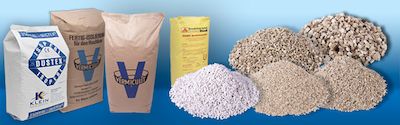
100 litre paper sacks, palleted à 24/27 sack or in Big Bags or loose silo loading.